
Fast-moving consumer goods (FMCG) distributors' association has written to the finance ministry, highlighting concern over fund utilisation and fund accumulation by quick commerce companies and deep discounting of goods on their platforms. According to a recent letter seen by Business Standard, All India Consumer Products Distributors Federation (AICPDF) noted that its analysis indicated that approximately 80 per cent of these funds were directed toward customer acquisition strategies instead of creating cutting-edge innovations or sustainable growth models for the retail sector.

From the Sensex pack, Bharti Airtel, Asian Paints, Infosys, Bharat Electronics, Tech Mahindra and Eternal were major laggards. However, Maruti, Tata Steel, Bajaj Finance, Bajaj Finserv, Trent and Tata Consultancy Services were among the gainers.

India's smartphone exports surged nearly fivefold to the US and about fourfold to Japan in the past three years, propelling the segment to surpass petroleum products and diamonds as the country's top exported goods, according to government data. The smartphone exports rose by 55 per cent to $24.14 billion in 2024-25 from $15.57 billion in 2023-24 and $10.96 billion in 2022-23.

The Cabinet can take a decision on the matter only after the Election Commission's approval.

'We have created massive infrastructure in the past six years.'

'The reported deal between the European Union and China should mitigate it (shortage) for the medium to long term. Let's wait and watch how this plays out.'

India on Thursday said the issue of trade did not come up at all in talks between Indian and American leaders during its military clashes with Pakistan, virtually rejecting Washington's repeated claims that its offer of trade stopped the confrontation.
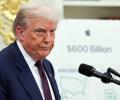
United States President Donald Trump has said India is 'very close' to China in terms of its purchases of Russian oil and will pay tariffs of 50 per cent as he indicated that 'you are going to see so much secondary sanctions'.

Digipin promises to revolutionise location-based services in India with safeguards.
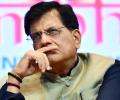
A government official said India and the US are exploring an interim trade deal within 90 days.

In the retail markets, rates have fallen to Rs 30-35 a kg from Rs 100-level.
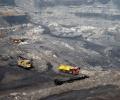
The 17 rare earth elements that are at the centre of the current crisis are critical components of everyday products -- from cars to jet engines to electronics like smartphones and flat-screen TVs.

The commerce ministry is working on different scenarios to assess the possible fallout of reciprocal tariffs to be imposed by the US administration on April 2 on its key trading partners including India, sources said. US President Donald Trump has said that April 2 will be 'Liberation Day' as he plans to announce tariffs or import duties to bring down America's trade deficit, and promote the country's manufacturing.

India on Thursday said it expects the United States to consider visa applications of Indian students on merit amid growing concerns over the Trump administration halting new student visa interviews.

China's Ministry of Commerce announced Tuesday it will impose counter tariffs on multiple American products, including a 15 per cent tariff on coal and liquefied natural gas, and a 10 per cent tariff on crude oil, agricultural machinery, and large-displacement vehicles.

A week after the devastating Air India plane crash in Ahmedabad claimed 270 lives, investigators on Thursday continued to sift for clues to ascertain the cause, while the government said the Aircraft Accident Investigation Bureau will decide where to decode the black box of the ill-fated Dreamliner.

By threatening to punish India with high tariff, Trump is actually planting a tantalising thought in the Indian mind that the Modi government should suitably 'incentivise' him, explains Ambassador M K Bhadrakumar.

The CII Business Summit 2025's inaugural session witnessed a rousing standing ovation and a felicitation ceremony for the defence top brass sending a strong message about India's rising military industrial complex and hghlghting that security is a top-of-the-mind issue for India Inc.

India's exports grew marginally by 0.7 per cent to $41.97 billion in March, while the trade deficit stood at $21.54 billion in the month, the latest government data showed on Tuesday.
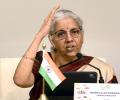
Issues related to the proposed free trade agreement (FTA) and bilateral investment treaty between India and the UK are expected to figure during the three-day visit of Finance Minister Nirmala Sitharaman to London from April 8-10, official sources said. The minister will attend a host of meetings, including the India-United Kingdom Economic and Financial Dialogue, in London.

Sector analysts in India feel that the new convention may not lead to a significant increase in the number of Indian employees being sent to the UK.
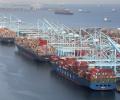
India and the US have decided to hold sector-specific talks in the coming weeks to finalise the structure of the proposed bilateral trade agreement (BTA), the government said on Saturday. The engagement between the two countries came in the backdrop of the USA's threat to impose reciprocal tariffs on its key trading partners, including India, on April 2.

Dismissing allegations that Indian phacosrmaceutical companies copy products of Swiss firms, Commerce and Industry Minister Piyush Goyal on Tuesday said it is a long-standing myth and India respects intellectual property rights and never steals technology from others. He said that Swiss pharmaceutical companies have not shown even a single instance that Indian companies have illegally copied any of their trademarks or patents or copyrighted technology.

The government is set to examine concerns over quick commerce companies potentially undermining businesses of local kirana stores, particularly in the context of the draft Digital Competition Bill, according to official sources. The Ministry of Consumer Affairs recently raised the issue with the Ministry of Corporate Affairs during discussions around the proposed legislation. "We need to assess if and how the Bill can address these concerns and explore further steps to include provisions to keep a check," a senior official stated.

In a major policy reversal, the AAP government wrote to the Centre to withdraw approval given by previous Congress government for FDI in multi-brand retailing in Delhi, saying the entry of global chains such as Walmart and Tesco in India would result in large-scale job losses.
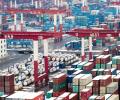
India's trade deficit with China neared $100 billion in FY25, amid escalating concerns of dumping, data released by the commerce department on Wednesday showed. Chinese imports rose by 11.5 per cent to $113.45 billion, while outbound shipments to the neighbouring country saw 14.5 per cent contraction to $14.2 billion.
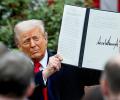
India is already negotiating a bilateral trade agreement with the US. The two countries are aiming to finalise the first phase of the pact by fall (September-October) of this year.

Maruti Suzuki India (MSIL) said on Thursday its operations are unaffected by the global rare earth magnet shortage, but added that the situation is "uncertain and evolving". The firm said it is exploring multiple solutions to maintain continuity in operations and will notify stakeholders in case of material impact.

The Indian exporting community is "very" concerned about the possible reciprocal tariffs of the US as it could severely hurt MSME shipments to America in the short run, Federation of Indian Export Organisations President SC Ralhan said on Wednesday. He suggested that the government should come forward and support exporters to deal with these tariffs.

Amid the ongoing global tariff war, Commerce and Industry Minister Piyush Goyal on Wednesday asked exporters not to panic and assured them that India is working on the "right mix and right balance" in its proposed trade agreement with the US.

The ministry, according to sources, held three special drives during June-July for weeding out and indexing of old files and records
'And America will invite India in to have really an extraordinary opportunity and relationship with us.'

The Food Safety and Standards Authority of India (FSSAI) has sought a meeting with quick-commerce (qcom) platforms like Blinkit, Swiggy Instamart and Zepto on Tuesday to discuss issues regarding violations of food safety standards, according to sources familiar with the matter. This comes at a time when there have been issues raised about food safety standard violations by qcom platforms for packaged food products, including violations related to expiry and best before dates.

Government employees in Bangladesh locked down the main gate of the Bangladesh Secretariat in Dhaka, protesting a new service law that allows for easier dismissal of officials for misconduct. The protest, which lasted for about half an hour, disrupted government operations. The employees also threatened to continue their protests until the ordinance was scrapped. Meanwhile, the protest by employees of the Dhaka South City Corporation, demanding the installation of BNP leader Ishraque Hossain as its mayor, has brought administrative services to a halt. These protests, coupled with concerns raised by the business community and the military, highlight a growing sense of unease in Bangladesh over the policies of the interim government.


The Slovak Republic's President, Peter Pellegrini, has expressed interest in adopting a tree-planting initiative similar to India's "Ek Ped Maa Ke Naam," launched by Prime Minister Narendra Modi. The inspiration came during a meeting with Indian President Droupadi Murmu, who was on a two-day state visit to Slovakia. During a tree-planting ceremony in Nitra, Murmu highlighted Modi's initiative to plant trees in the name of mothers. Pellegrini was impressed and suggested that Slovakia could consider a similar program. The initiative, launched on World Environment Day last year, encourages people to plant a tree in their mother's name as a symbolic gesture of love and respect.

A new cyber fraud known as 'pig butchering scam' or 'investment scam' has emerged, targeting unemployed youths, housewives, students, and needy people who are made to lose large sums of money daily, according to the latest annual report of the Union home ministry.
India and the US have finalised the terms of reference outlining the roadmap for negotiations of the proposed Bilateral Trade Agreement (BTA), according to a statement issued by the US. US Trade Representative (USTR) Jamieson Greer said that these ongoing talks will help achieve balance and reciprocity by opening new markets for American goods and addressing unfair practices that harm US workers.

The Indian government has appointed Finance Secretary Tuhin Kanta Pandey as the new chairman of the Securities and Exchange Board of India (SEBI). Pandey, a 1987-batch IAS officer, will replace Madhabi Puri Buch, whose three-year tenure ends on February 28. Pandey's appointment comes at a time when the markets are experiencing bear pressure due to withdrawals by foreign institutional investors (FIIs). Pandey has extensive experience in the finance ministry, having served as the longest-serving secretary in the Department of Investment and Public Asset Management (DIPAM) and the Department of Public Enterprises (DPE). He also played a key role in the framing of the 2025-26 Budget and the drafting of the new Income Tax Bill. Pandey's appointment is for an initial period of three years.
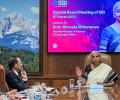
Finance Minister Nirmala Sitharaman on Saturday said India is looking for a "good" trade agreement with the US to promote economic growth and ensure smooth supply chains. She also said that amid a growing global tariff war, India will have to move "smartly" to guard against possible dumping of goods from countries that are facing higher US tariffs.
